1. Home
  2. >
  3. Arboriculture Services
  4. >
  5. Trimming Services

Our Pruning Services

Tree pruning consists in reducing the length and number of useless or harmful branches to increase the life expectancy of a tree, and boost its vitality and resistance to disease. In light of the needs of each tree, various interventions can be made: rebalancing of the drip line, clearing branches, crown reducing and shaping of tree, coniferous tree pruning, crown enhancement, thinning, trimming, formative pruning, rejuvenation pruning, or yet, sanitation cutting.

Our certified team of arboriculturists customizes each intervention to the particular species, physiology and environment of the tree, while ensuring a lasting, safe and eye-pleasing result.

Rebalancing of the Drip Line

Rebalancing the drip line consists in cutting certain branches on a tree in order to enhance the growth of other branches to create a sap-drawer that will help it return to its natural shape. This type of pruning may become necessary, particularly when part of the tree top has broken off.

Thinning

Thinning consists in eliminating some branches in order to lighten and bring more airflow to a tree. By improving light penetration and increasing air circulation, the risks of fungal diseases are therefore diminished.

Coniferous tree pruning

Coniferous tree pruning is usually performed when clearing branches from structures. The ideal time to do so is from May to June, to avoid pruning during heatwaves. It is recommended that no more than 25% of the leaf mass be removed. A good sap-drawer is essential to fostering the tree’s health when pruning.

Sanitation cutting

Sanitation cutting consists in removing all branches that could be harmful to the tree, thus preventing any eventual problems that could affect its health.

Crown Reducing & Shaping of Trees

Crown reducing and shaping of a tree is aimed at rebalancing its structure following a radical trimming such as the topping of a tree or breakage caused by bad weather. Consequently, the tree will continue to grow by creating several offshoots on the branches. By selecting the best offshoots for the tree species, these will constitute its news structure. An assessment must be made throughout the years to eliminate harmful offshoots.
Plant thinning

Plant thinning

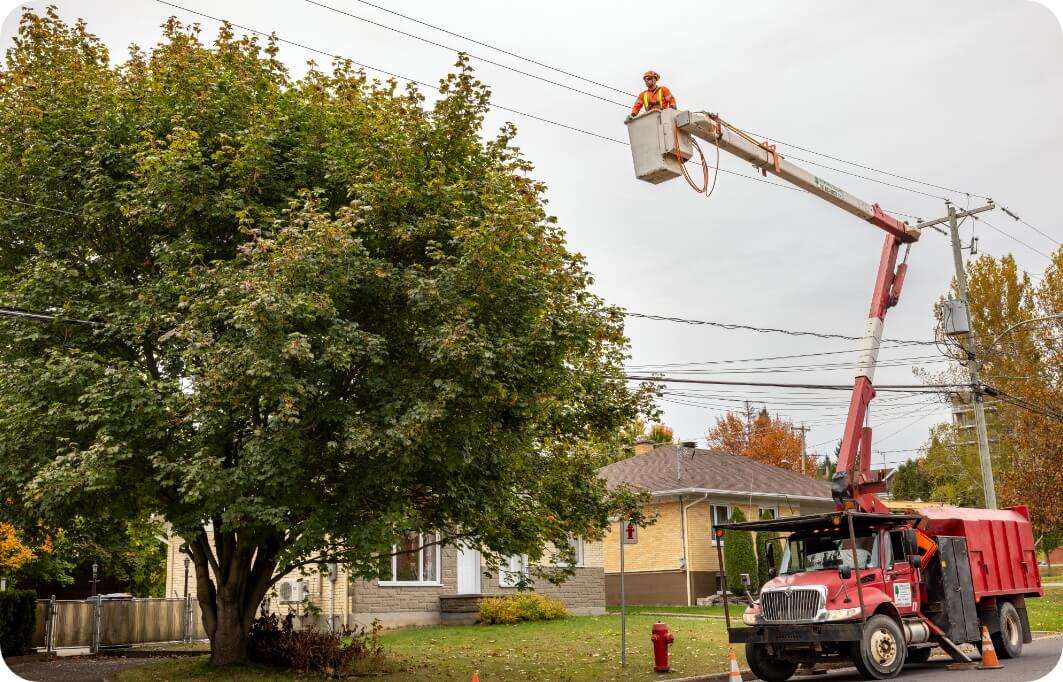
Plant thinning is the pruning of trees that are in close proximity to infrastructures such a Hydro-Québec transmission lines, buildings, roads, street lights, etc. This plant thinning is executed in a manner that redirects growth away from these structures while also taking the tree’s sap-drawer into account.

Crown enhancement

Crown enhancement is a pruning technique that consists in removing the lower branches of a tree in order to ensure proper clearance from the ground, at the necessary height. This type of pruning can be done, in particular, to ensure easy access to entrances, bike paths and parking areas.

Trimming

Trimming consists in removing small offshoots at the extremities of branches (twigs) and the suckers that normally grow at the base of the tree or on parts of the trunk that are too exposed. The goal of trimming is to slow the elongation of branches and mildly increase foliage density.

Formative pruning

Formative pruning consists in shaping a tree in its early growth stages, in order to give it a more aesthetic structure while developing.

Complete tree maintenance

Complete tree maintenance is performed on trees requiring more than one type of service to meet their needs. For instance, a tree could require a rebalancing of the drip line, a crown reducing and shaping, as well as a crown enhancement.

Rejuvenation pruning

Rejuvenation pruning is a pruning technique used to revitalize a tree, often a fruit or ornamental tree, that has become too old or crowded, or is less productive. This consists in eliminating a large part of the older branches or those less apt to stimulate new and vigorous branch growth. The goal is to rejuvenate the tree by fostering new wood growth which will improve its health and structure, and, in the case of fruit trees, its fruit production.

This pruning is usually done during winter when the tree is dormant, to minimize stress on the tree. Dead, diseased or overly dense branches are pruned, and sometimes, the height of the tree is drastically decreased to give it a more balanced shape. This is a considerably severe operation so it must be well-planned to avoid excessively weakening the tree.
Pruning